Imam Hassan al-Banna
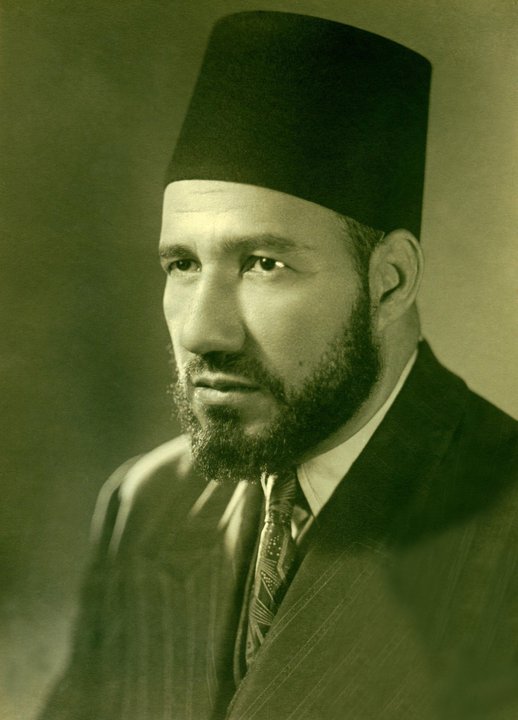
Hassan Al-Banna was born in 1906 in Mahmoudia, near Alexandria, Egypt. He graduated from Dar Al-Uloum school in Cairo and worked in the field of education in several towns, calling people to follow the Qur'an and the Sunnah. He was able to guide to the Path of Allah thousands of people of all classes of his society
. 
Imam Al-Banna stayed in
Ismailiah, Egypt for some time where he established the first center for
Al-Ikhwan with a group of his brothers. He started making Da'wah in
public through lectures and publications and visits to villages and
towns. His activity was not only confined to men, he also established in
Ismailiah "The Muslims' Mothers Institute" for educating girls
according to Islamic teachings.
After some time he was
transferred to Cairo to which he transferred his headquarters. Cairo
became the center of Da'wah and in a short time the number of Ikhwan
reached about a half million. This enormous progress started to concern
the British and their followers, the Egyptian politicians. They tried to
dissuade Imam Al-Banna from politics but he insisted on his position.
He established a daily newspaper in Cairo by the name "Al-Ikhwan
Al-Muslimoon" which enabled him to address a much larger sector of the
public than with lectures.
When the tragedy of Palestine took
place, the Ikhwan troops were among the most active forces and were able
to reach to the gates of Tel Aviv and almost conquered it if it had not
been for the treason by the Arab rulers at that time. Furthermore, King
Farouq of Egypt imprisoned a large number of Ikhwan. Finally, a plot
was made by the British and implemented by their servants to assassinate
Imam Al-Banna. He was shot in front of the "Muslim Youth Association"
building in March 1949. After he was carried to the hospital, he was
left on the floor bleeding with no one trying to save him. Two hours
after he was shot, he passed away, at only 43 years of age.
Who Is Hassan Al-Banna
Anyone
who knows the martyred Imam closely realizes how he surprised Egypt and
the whole world with his Da'wah and his strife. Al-Banna, may Allah
have mercy on him, possessed a multitude of characteristics that may
seem contradicting with one another from the point of view of
psychologists or historians. He was brilliant, sympathetic, ambitious
for the future of his Da'wah yet easily satisfied by very little in his
private life. He was eloquent, steadfast and humble. All these
characters helped to form an example of religious and social leadership
that the whole world had not seen for centuries.
At the age of
9, Hassan Al-Banna memorized two thirds of the Qur'an. Shortly after
that, he finished memorizing the whole Qur'an. He was an excellent
speaker. He had the ability to improvise speeches for almost any
occasion for whatever audience he happened to be addressing. He was
superb in his ability to get his ideas across to his audience, supported
by verses from the holy Qur'an and by Hadiths, both of which he
mastered very well. The unique quality the martyred Imam enjoyed was his
ability to gather people's hearts around him and bind them together
with the link of brotherhood in Islam.
An unforgettable quality
of Imam Al-Banna was his persistence and diligent work for propagating
his message. He always traveled, gave lectures and Khutbahs, had
discussion with people, worked day and night and never knew what it was
like to relax or go on vacation.
Establishment Of Jamaa'at Al Ikhwan
\We
let the Imam narrate the story: "Since my childhood I have devoted my
life to a single purpose; that is to guide people to the truth of Islam,
concept and practice. However, this objective remained for some time as
thoughts that come to my mind from time to time; I sometimes spoke
about them to those around me in the form of a speech or a lesson at a
masjid whenever possible. I tried to encourage some of my Ulama' friends
to redouble their effort in preaching to people in order to guide them
to the reality of Islam. I also spoke with people of high social
standing, urging them to work for the cause of Islam; their response was
anywhere from frustration to encouragement to indecisiveness. But when I
realized I could not get what I wanted in terms of seriousness to work
and organize efforts, I turned toward my brothers and friends with whom I
had the link of sincere love and common appreciation of responsibility.
"In Dhul-Qi'dah, 1347 H (March, 1928), six brothers visited me:
Hafez Abdel-Hamid, Ahmad Al-Hossary, Fuad Ibrahim, Abder-Rahman
Hasab-Allah, Ismael Ezz and Zaki Al-Maghraby. We gave our pledge and
swore that we would live as brothers working for Islam and strive in its
cause.
"One of us said: `What should we call ourselves? Should
we form an association, a club or an organization?' I said: `No! Let's
not worry about formalities, let's concentrate on practical issues. We
are brothers who work for Islam, so we are Al-Ikhwan Al-Muslimoon (The
Muslim Brothers).
"That was the birth of the first group of
Al-Ikhwan, consisting of these six people who gathered around the
principle. Under this name we started working with a clear and
comprehensive understanding of Islam. As a result the Da'wah of
Al-Ikhwan comprised all aspects of reformation of the Muslim Ummah."
Imam
Al-Banna, may Allah have mercy on him, established his Da'wah on
several pillars which he considered to be of utmost importance, among
those pillars are:
1. Singleness of purpose,
2. Gathering people around the basic principles of Islam and not worrying about minor differences,
3. Following the proper Islamic manners in case of disagreement,
4. Thinking positively of those who disagree with one's idea,
5. Avoiding despotism,
6. The possibility of more than one right opinion for a single issue,
7. Cooperation in what is agreed upon and forgiveness in what is disagreed upon,
8. Calling all Muslims to face the common enemy,
9. Encouraging work and productivity, and
10. Feeling of pity, not malice, for those who have gone astray.
Among His Sayings....
•O
sincere brothers! Our pledge has ten pillars, remember them:
understanding, sincerity, work, strife, sacrifice, obedience,
steadfastness, singleness of purpose, brotherhood and confidence.
•Revive
your conscience by believing in Allah and remaining mindful of Him;
protect your communities by enjoining what is right and forbidding what
is wrong; these are the two pillars of reformation.
•Islam
performs two tasks: First, it molds the individuals into a new shape
based on Aqidah and noble human qualities; it then uses these
individuals as building units to establish the righteous Allah-mindful
communities.
•Islam is an Aqidah (creed) as well as a
nationality. Unlike nationalities which are based on land, the
nationality of Islam is based on brotherhood in faith and, therefore, is
far stronger and more meaningful than the former.
